
Evaluación de tratamientos pregerminativos en semillas de Molle de beber (Lithraea molleoides(Vell) Engl.)
DOI:
https://doi.org/10.63207/ai.v8i16.161Palabras clave:
germinación, tratamientos térmicos, Anacardiaceae, Lithraea molleoidesResumen
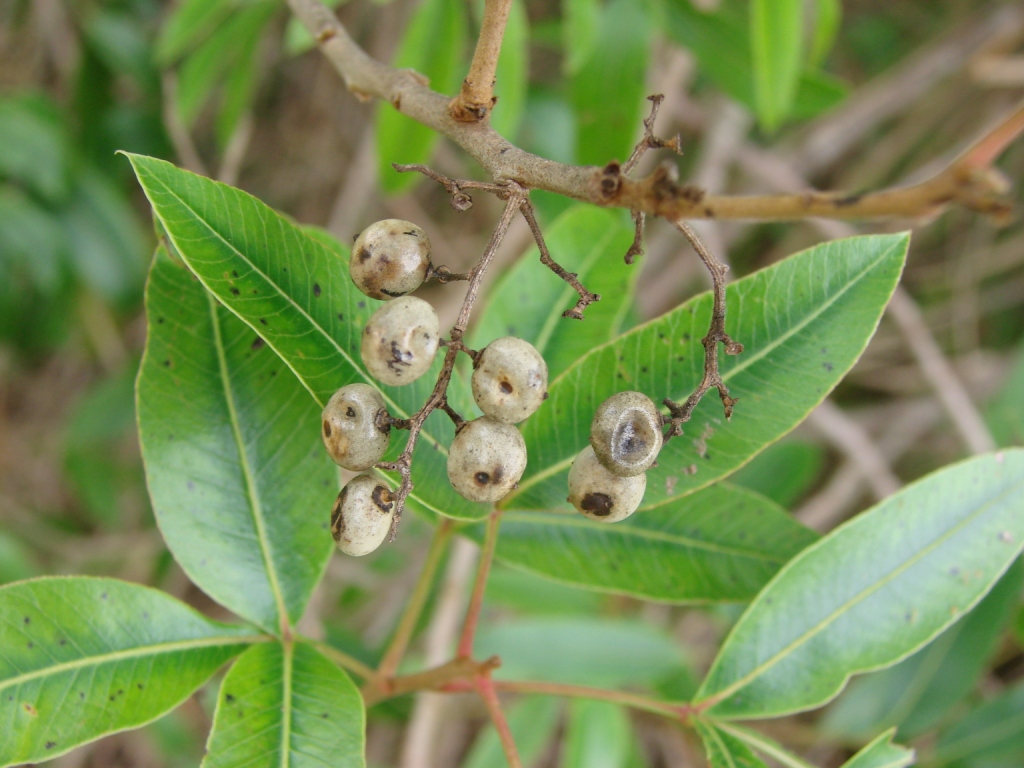
Lithraea molleoides (Vell.) Engl., es una especie arbórea dominante de la familia Anacardiaceae en el Chaco Serrano, caracterizada por su hábitat orófilo. La propagación de esta especie se ve limitada por la baja germinación de sus semillas, lo que hace necesario el desarrollo de tratamientos pregerminativos eficaces. Este estudio evaluó el efecto de diferentes tratamientos térmicos sobre la germinación de L. molleoides durante 30 días, mediante observaciones periódicas. Se aplicaron cinco tratamientos: inmersión prolongada a 100°C (T1) y 85°C (T2) durante 48 h; inmersión breve a 100°C (T3) y 85°C (T4) durante 5 min; y un testigo sin tratamiento térmico (T5). Los resultados mostraron diferencias significativas en el poder germinativo entre tratamientos (p < 0.0001). Los mayores porcentajes de germinación se obtuvieron con los tratamientos a 85°C (T2: 44%; T4: 43%), superando significativamente a los tratamientos a 100°C (T1: 9%; T3: 12%) y al testigo (T5: 7%). Estos resultados demuestran que las temperaturas de 85°C, independientemente del tiempo de exposición (5 min o 48 h), optimizan la germinación de L. molleoides, probablemente al favorecer la permeabilidad del tegumento sin dañar el embrión.
Descargas
Citas
Baskin, C. C., & Baskin, J. M. (2021). Seeds: Ecology, biogeography, and evolution of dormancy and germination (2nd ed.). Academic Press.
Bewley, J. D., Bradford, K. J., & Hilhorst, H. W. M. (2022). Seeds: Physiology of development, germination and dormancy (4th ed.). Springer Nature.
Fernández-Pascual, E., Seal, C. E., & Pritchard, H. W. (2021). Simulating the germination response to diurnally alternating temperatures under climate change scenarios: Comparative studies on Carex diandra seeds. Annals of Botany, *127*(6), 807-817.
Gomes, M. P., Garcia, Q. S., Oliveira, J. A., Silva, F. G., & Ribeiro, D. M. (2023). Cellular damage markers in heat-treated seeds: Histological and biochemical approaches. Seed Science Research, 33(1), 12–25.
Gomes, M. P., Garcia, Q. S., & Oliveira, J. A. (2023). Seed priming with phytohormones: A strategy to enhance germination under abiotic stress. Plant Growth Regulation, *99*(1), 1-15.
International Seed Testing Association [ISTA]. (2023). International rules for seed testing. https://www.seedtest.org/en/international-rules-_content---1--1083.html
Lamont, B. B. & He, T. (2022). «Fire-mediated germination syndromes in Mediterranean ecosystems». Trends in Plant Science, 27(7), 668-681.
Lamont, B. B., Pausas, J. G., & He, T. (2024). Fire as a key driver of seed traits in Mediterranean ecosystems. Trends in Plant Science, *29*(2), 123-135.
Landis, T. D., Dumroese, R. K., & Haase, D. L. (2021). The Container Tree Nursery Manual: Volume 2 – Containers and Growing Media. USDA Forest Service.
Moreira, B., Castellanos, M. C., & Pausas, J. G. (2020). Fire-driven germination in Mediterranean basins: Heat shock thresholds and their interaction with water availability. Plant Ecology, 221(7), 569–581. https://doi.org/10.1007/s11258-020-01034-z
Moreira, Tavşanoğlu, Ç., & Pausas, J. G. (2021). Lethal temperature thresholds for seed germination in Mediterranean species. Plant Ecology, 222(3), 433–445.
Moreira, B., Castellanos, M. C., & Pausas, J. G. (2021). Fire-related cues break physical dormancy in Mediterranean Basin flora. Annals of Botany, 127(5), 647–659.
Nonogaki, H. (2019). Seed germination and dormancy: The classic story, new puzzles, and evolution. Journal of Integrative Plant Biology, *61*(5), 541-563.
Oliveira, G., Ribeiro, J. S., & Santos, T. M. (2023). Optimizing peat-perlite-sand mixes for seed germination: Physical properties and seedling performance. Scientia Horticulturae, *321*, 112289.
Pausas, J. G., Lamont, B. B., Paula, S., & He, T. (2022). “Duration and intensity of heat shocks affect germination differently in fire-prone ecosystems”. Frontiers in Plant Science, 13, 891543.
Pedrini, S., Balestrazzi, A., Madsen, M. D., & Bhalsing, K. (2020). Seed enhancement: Getting seeds restoration-ready. Restoration Ecology, *28*(S3), S266-S275.
Peguero-Pina, J. J., Mendoza-Herrer, Ó., Morales, F., & Gil-Pelegrín, E. (2022). Hydric and light regulation of seed germination in Mediterranean trees: Ecological implications under climate change. Forests, *13*(2), 323.
Pereyra, D. A., Gurvich, D. E., & Funes, G. (2024). Thermal scarification protocols for native species of the Gran Chaco. Neotropical Ecology, 12(1), 45–60.
Pritchard, H. W., Daws, M. I., & Mattana, E. (2023). «Water relations in seed germination: New thresholds for tropical species». Seed Science Research, 33(1), 45-58.
Torres, R. C., Renison, D., & Tecco, P. A. (2023). «Seed germination constraints in Argentinean dry forest species: Climate change implications”. Forest Ecology and Management, 529, 120697.
Vázquez-Yanes, C., Orozco-Segovia, A., & Sánchez-Coronado, M. E. (2022). “Seed vigour and hydration dynamics in pioneer species: Implications for ecological restoration”. Journal of Seed Science, 44(3), e2022440302.
Zapater, M. A., Campos, C. M., & Tálamo, A. (2021). “Historical fragmentation explains current distribution patterns in seasonally dry tropical forest species”. Journal of Biogeography, 48(5), 1189-1203.
Zhang, H., Liu, X., & Wang, Y. (2022). Mechanical scarification and hydrogen peroxide breaking seed dormancy in native legumes: Implications for ecological restoration. Journal of Environmental Management, *305*, 114387.
Descargas
Publicado
Cómo citar
Número
Sección
Licencia
Derechos de autor 2025 Kevin Joao Palacios Ballesteros, José Omar Plevich, Juan Carlos Tarico, Marco Jesús Utello

Esta obra está bajo una licencia internacional Creative Commons Atribución-NoComercial 4.0.